Why SAP Still Wins, and What Comes Next
While the first wave of AI around SAP makes enterprise systems easier to implement, understand, and use, the real value will come from Decision Agents that turn systems of record into systems of intelligence for continuous, uncertainty-aware decision-making.
Why SAP Still Wins
SAP persists for a reason.
It is not because people love the interface. It is not because the workflows are intuitive. It is not because enterprises enjoy spending years and hundreds of millions of dollars on transformation programs. SAP persists because it has become the encoded memory of how a company actually operates. It holds the canonical data model, the approvals, the controls, the posting logic, the exception handling, and the accumulated business logic that has built up over decades. That is what makes it so hard to replace, and why augmentation is a more realistic wedge than rip-and-replace.
a16z makes this point well in Why the World Still Runs on SAP. The article is right that the next generation of software will not begin by replacing systems of record. It will begin by building on top of them. The interface, automation, and extension layer is becoming the new software frontier.
The First Wave: Implementation, Documentation, and Enablement
Most of the companies highlighted in the article fit that thesis neatly. They help enterprises understand SAP data, implement SAP faster, or make SAP easier to work with. Some reduce migration risk. Some generate semantic documentation and process maps. Some help teams navigate the complexity of enterprise software without needing to memorize every screen, table, or workflow. These are real problems, and they matter. Implementation pain is enormous. Day-to-day usage is fragmented. Users constantly switch between applications, wait for reports, and depend on specialists to retrieve information.
This is where the first wave of AI around ERP begins: Implementation Agents, Semantic Documentation Tools, and Enablement Agents.
- Implementation Agents reduce transformation pain. They turn messy project artifacts into structured requirements, mappings, test plans, and migration workflows. They compress the cost and uncertainty of major SAP programs.
- Semantic Documentation Tools keep system knowledge current and accessible. They turn scattered process knowledge, customizations, dependencies, and business logic into a living semantic layer that teams can actually work with.
- Enablement Agents turn training and rollout into a repeatable product. They help teams, partners, and channels adopt complex enterprise systems more consistently and at lower cost.
Together, these layers make SAP easier to implement, easier to understand, and easier to use.
Figure 1. The Four Layers of AI Around ERP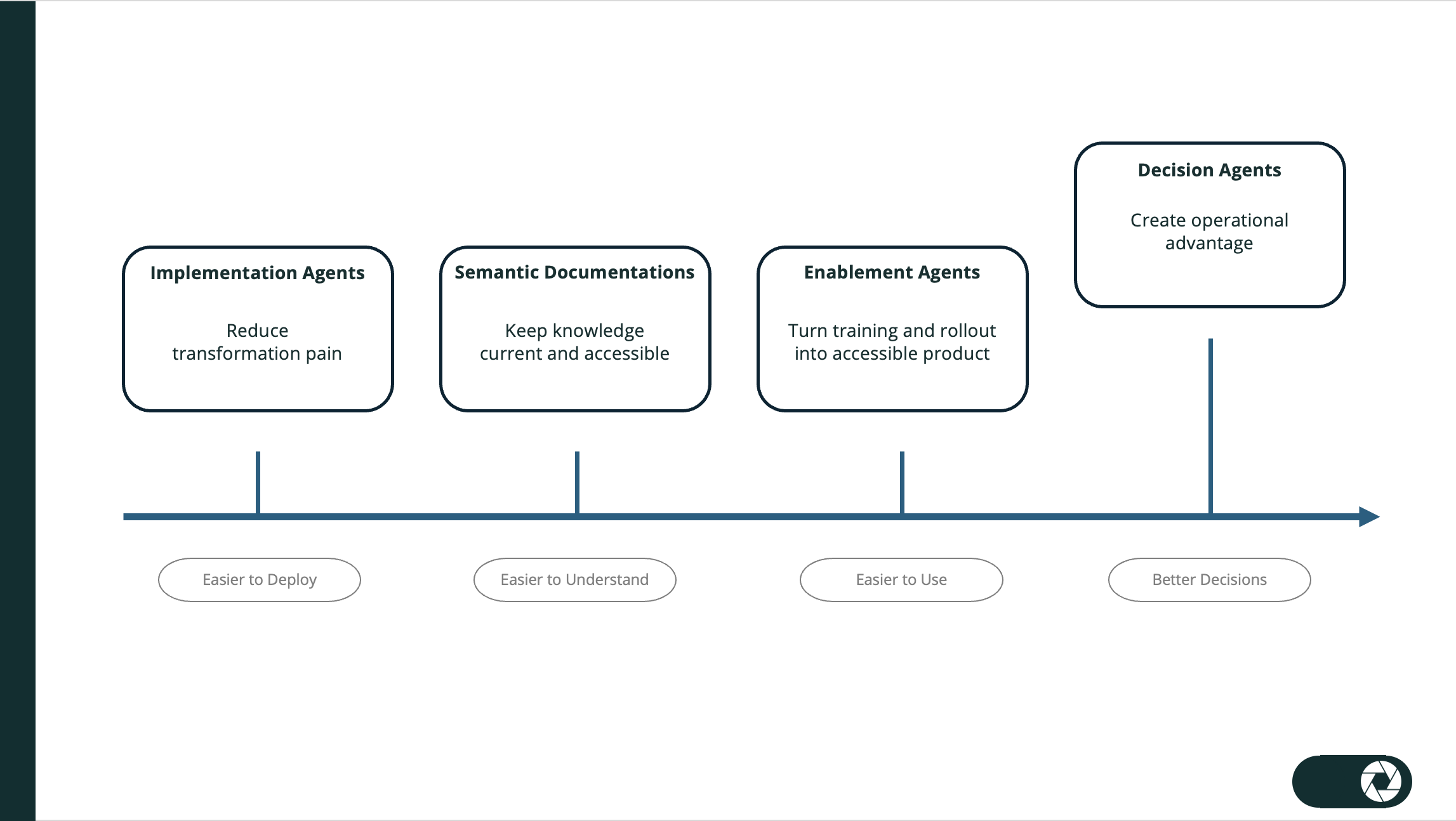
The Missing Layer: Decision Agents
But they still stop short of the real bottleneck.
They help people understand the system better. They help people move through the system faster. They do not fundamentally improve the quality of the decision itself.
That distinction matters much more in operations than in most other domains.
In supply chain, the hard question is rarely, “Which screen should I click?” It is, “What changed, what breaks, what is the tradeoff, and what should I do next?” A better copilot can help retrieve a report. A thinner interface can reduce friction. But neither tells you how to respond when lead times move, a port gets congested, demand shifts, or a pricing decision cascades into service-level and inventory consequences.
That is where the next category begins.
The missing layer is Decision Agents.
Decision Agents do not just retrieve data or trigger actions. They reason over uncertainty. They simulate scenarios. They optimize across constraints. They recommend next-best actions with auditability. They do not just help users operate the system of record. They help users steer the business.
Figure 2. System of Record vs. System of Intelligence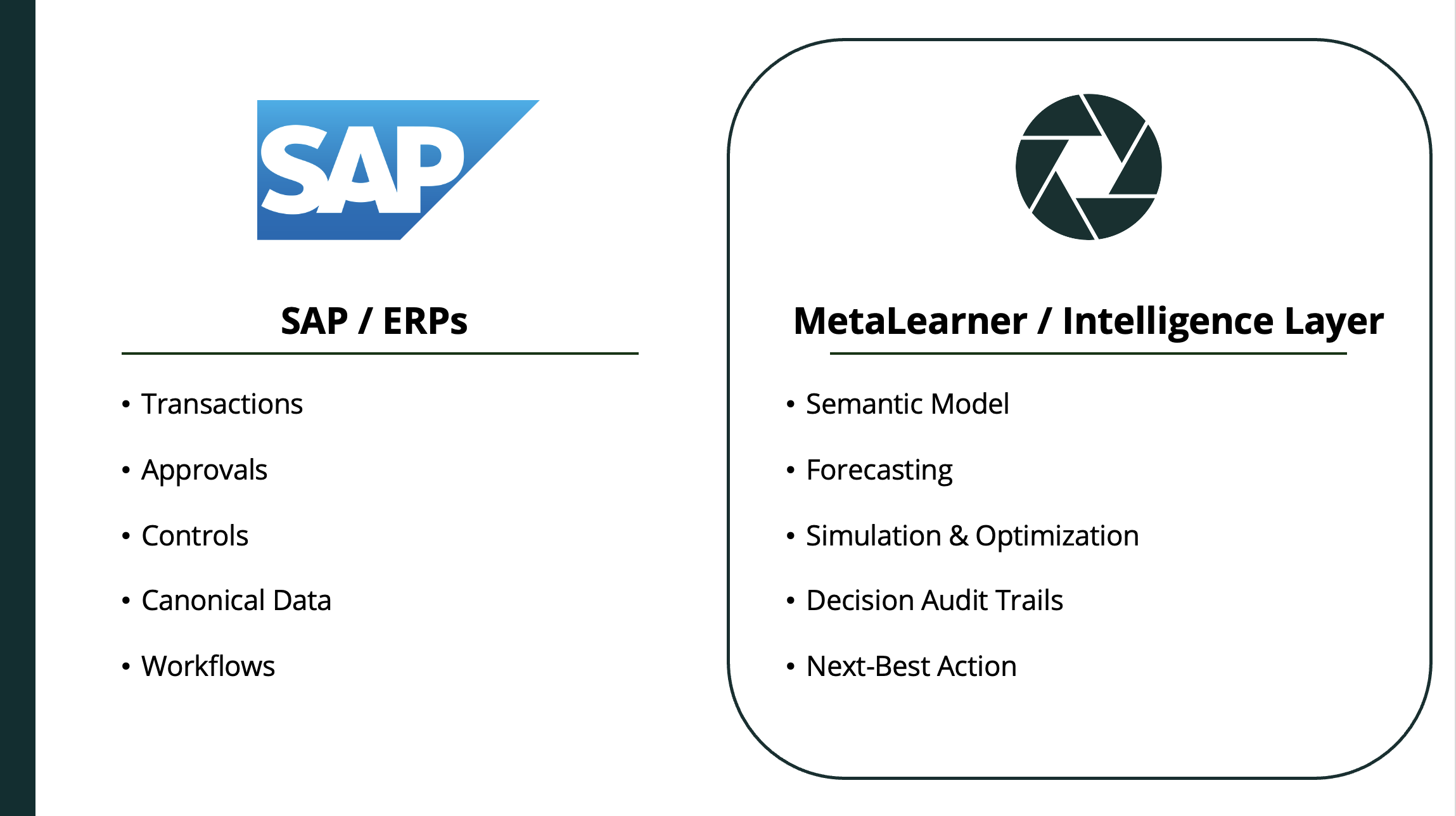
From System of Record to System of Intelligence
This is the layer MetaLearner is built for.
If SAP is the system of record, MetaLearner becomes the system of intelligence. We translate ERP data into a semantic model of the business, then use forecasting, simulation, optimization, and audit trails to make that data decision-ready under uncertainty. This is not about wrapping SAP in a prettier UI. It is about turning a transaction system into something machines can reason over in operational terms.
That is the deeper opportunity that sits beyond dashboards, copilots, and workflow automation.
Approachability is necessary, but not sufficient. Making SAP easier to use is valuable, but the larger economic value comes from helping enterprises make better decisions on top of SAP. Not static decisions. Not spreadsheet decisions. Continuous decisions that adapt as the world changes.
Figure 3. Static Planning vs. Continuous Decisions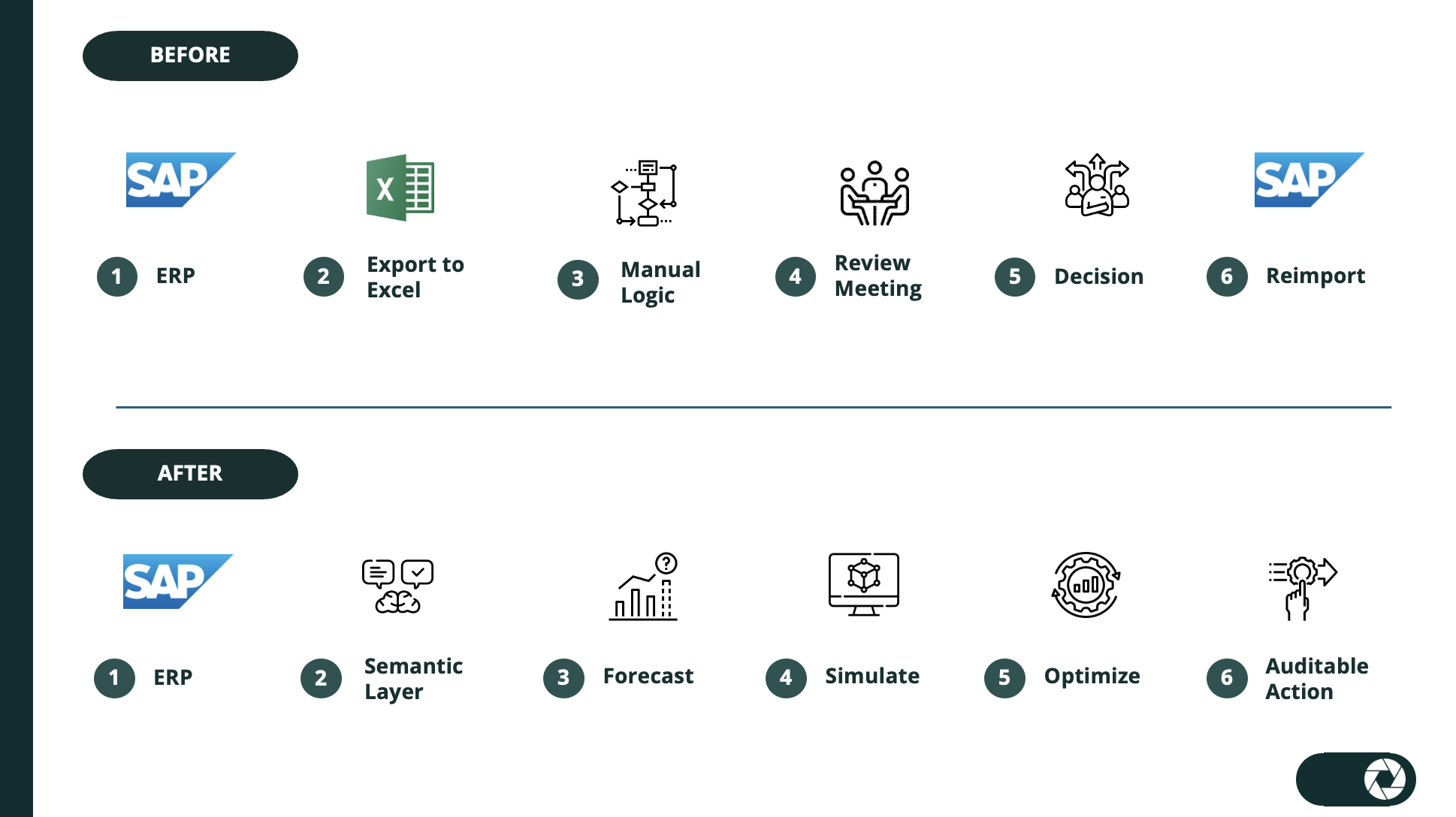
Why This Category Is Opening Up Now
This is also why the category is opening up now. For years, enterprise AI was framed as a model problem. In practice, the bottleneck was structure. The data existed, but not in a form machines could reason over reliably. What changed is that systems of record have become legible enough to model semantically, and foundation models have become capable enough to operate effectively once they are given the right constraints, context, and tools. The new moat is no longer just the model. It is the decision architecture built around it.
The next wave is Decision Agents, which create operational advantage.
What MetaLearner Is Building
The world still runs on SAP because SAP stores the business. The next generation of software will win by helping enterprises reason over that business, act on it safely, and adapt continuously as conditions change.
That is the layer we are building at MetaLearner.
