Stop Buying Service With Inventory
For decades, companies have managed uncertainty in essentially the same way.
Forecast demand. Add safety stock. Carry more inventory.
If demand becomes less predictable, increase the buffer. If management wants a higher service level, increase the buffer again. If lead times become uncertain, add still more inventory.
The logic is understandable. Inventory is tangible. It feels safe.
But the result is often paradoxical: businesses can be overstocked and understocked at the same time. They may carry substantial inventory in aggregate while still suffering stockouts on the products, locations and customer commitments that matter most.
The issue is therefore not only how much inventory the company owns. It is where that inventory sits, which risks it is protecting, and whether the next dollar of stock actually improves service.
Inventory is capital allocated against uncertainty. MetaLearner asks whether that capital is being allocated efficiently.
The old equation
Traditional inventory planning implicitly follows a familiar equation:
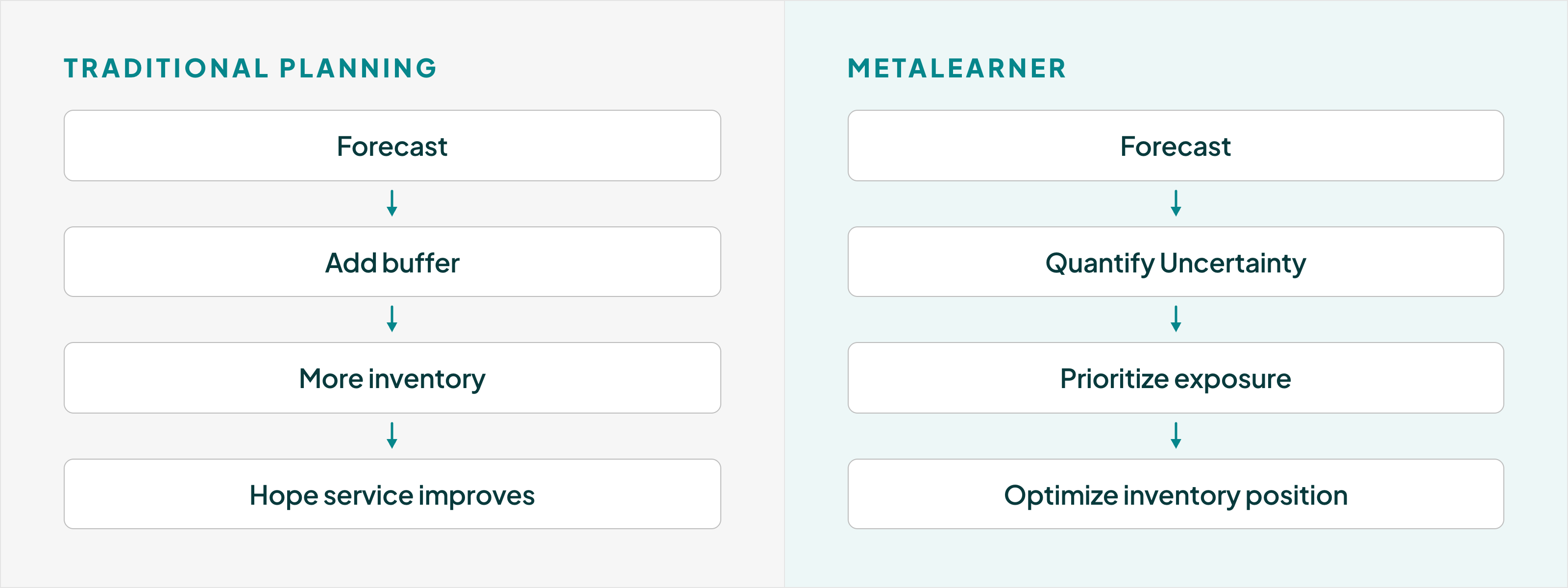
A buffer is simple, but it protects broadly. It can add inventory to products that are already well protected while still failing to protect a critical SKU at the location where risk is concentrated.
MetaLearner instead asks which uncertainties materially threaten the service objective, which products and locations carry the greatest exposure, and where additional inventory actually changes the outcome.
What decision remains effective across many plausible futures?
That is the essence of robust optimization. In MetaLearner's work on enterprise inventory problems, better forecasts did not eliminate misplaced inventory, stockouts or operational firefighting. The bottleneck moved downstream: from prediction to decision.[1][2]
Businesses do not ultimately make forecasts. They make decisions: how much to order, when to order it, which warehouse needs it, which SKU should receive scarce working capital, and what to do if realized demand differs materially from the forecast.
Those are optimization questions, not merely forecasting questions.
Stop buying service with inventory
This creates what should become the central economic message around MetaLearner:
STOP BUYING SERVICE WITH INVENTORY.
Higher service. Less capital. Better decisions.
Customer service and working capital have traditionally been presented as a trade-off. Want a higher service level? Hold more inventory.
MetaLearner is attempting to bend that frontier by using better forecasting, uncertainty quantification and robust optimization to find a more capital-efficient inventory position for a desired service level.
A real-world MetaLearner backtest illustrates the principle. Across 52 weeks, 17 warehouses and 63 items, MetaLearner's robust optimization framework achieved a 94.9% service level with average inventory of $4.51 million. The strongest forecast-plus-buffer benchmark required about 40% more inventory while delivering a service level that was still 1.9 percentage points lower.[1]
That is what makes the MetaLearner proposition fundamentally different from another AI forecasting product.
A buffer protects broadly. Robust optimization protects selectively.
That is the distinction MetaLearner is trying to operationalize: not less inventory everywhere, but more deliberate protection where the business is genuinely exposed.
The CFO question
This becomes particularly powerful when viewed through the balance sheet rather than through the lens of software.
Across portfolios analyzed in MetaLearner deployments, customers have been carrying inventory equivalent to approximately 25% of annualized sales. At around a 95% service level, MetaLearner's optimized inventory requirement was approximately 2-6% of annualized sales for the portfolios studied.
These figures should not be interpreted as a universal promise. Inventory economics differ dramatically across sectors, product portfolios, lead times, perishability, supplier reliability and service requirements. But they illustrate the scale of the question.
Imagine a company generating $1 billion of annual revenue. If it carries approximately $250 million of inventory, MetaLearner's client summary illustrates an efficient inventory position of roughly $20-60 million at around 95% service for comparable observed portfolios, with a possible working-capital opportunity of approximately $190-230 million depending on the starting position.
That is no longer a discussion about whether an AI project can save a few million dollars of operating expense.
$1B in sales. How much cash is hiding in the inventory?
Even releasing a fraction of unnecessary inventory can create capital that could be used to reduce debt, fund expansion, finance acquisitions, increase dividends, invest in manufacturing capacity or strengthen liquidity. The financial question is no longer whether an AI project can save a few million dollars of operating expense. It is how much capital the organization is using to compensate for uncertainty.
That is why the natural economic buyer for MetaLearner is the CFO. The operational champion is the COO, Chief Supply Chain Officer or VP of Supply Chain. The planning organization becomes the daily user.
Better forecasts are necessary. They are not enough.
MetaLearner initially attacked part of this problem through forecasting. Across deployments, the company has reported material improvements over customer baselines, but its subsequent research exposed something more important: better forecasts did not automatically create proportionally better operational outcomes.[1][2]
There is a simple reason. Forecast accuracy and decision quality are related, but they are not identical.
A highly accurate demand forecast does not tell management how to allocate scarce capital between two products. It does not automatically incorporate warehouse constraints, lead times, payment lags, liquidity requirements or service-level objectives. It does not determine whether inventory should be positioned in Miami, Singapore or Santo Domingo. And it cannot guarantee that tomorrow will resemble the historical distribution from which the forecast was produced.
MetaLearner's robust optimization framework therefore reasons jointly across products, warehouses, lead times, inventory positions, fulfillment requirements and cash constraints. Its rolling-horizon architecture observes reality, updates the state of the system and recomputes decisions rather than committing the enterprise to a static long-term plan.[1]
Prediction becomes an input. The decision becomes the product.
Intelligence per unit of compute
There is another important piece of the MetaLearner story. Enterprise AI cannot simply become more intelligent by consuming exponentially more computation. At enterprise scale, brute force becomes an economic problem.
MetaLearner's forecasting architecture uses feature selection, parallelized model training, meta-learning, ensembles and uncertainty estimation to identify the variables and models that matter for individual time series rather than assuming that every product should use the same forecasting architecture.[4][5]
The principle is important beyond forecasting: the objective is not maximum compute. It is maximum useful intelligence per unit of compute.
The optimization layer follows the same philosophy. MetaLearner formulates the decision problem as a continuous linear program and uses rolling-horizon control with NVIDIA cuOpt so repeated solves can remain practical at enterprise scale.[1]
The technology therefore serves the economics. Compute is not the product. Better decisions are.
But there is an even deeper problem: the ERP does not know why
Even the best optimizer operates on a representation of the business. And every experienced planner knows something the ERP does not.
A planning system may recommend ordering 40,000 units. An experienced operator looks at the recommendation and says: "That will not work."
Perhaps the supplier is technically active but notoriously unreliable during a particular season. Perhaps a customer classified as stable is about to run a promotion. Perhaps a warehouse looks available in the ERP but is operationally constrained. Perhaps the product hierarchy says two SKUs are substitutes while salespeople know that customers treat them very differently.
When the planner overrides the recommendation, most systems capture the change. They do not capture the reason.
MetaLearner describes this missing layer as an experiential ontology: a structured representation of what changed, why it changed, under what conditions it happened and what the decision implies downstream. Instead of treating human intervention as noise, the system treats it as a source of learning about how the organization really works.[2]
ERP records what happened. The experiential ontology learns why.
Where HASH by 2202 becomes important
This is also where the MetaLearner architecture can become substantially more powerful when combined with HASH by 2202.
An experiential ontology cannot compound reliably if the underlying business representation is ambiguous. Before MetaLearner can learn why a planner changed an inventory recommendation, the system needs confidence about what the relevant customer, product, warehouse, supplier, inventory position, unit of measure, cost and service metric actually mean.
HASH by 2202 has been built around this lower layer: reconstructing ERP environments as governed enterprise ontologies - machine-readable networks of entities, relationships, definitions, metrics, permissions and lineage that express what the business actually means.[3]
SAP, Oracle, NetSuite and other enterprise platforms are exceptional systems of record, but companies do not operate as collections of tables. They operate as networks of customers, products, suppliers, invoices, warehouses, prices, contracts, routes, inventory positions, receivables, rules and relationships.
The HASH architecture starts with questions such as: What exactly constitutes available inventory? Which customer hierarchy is authoritative? Does quantity mean units, boxes or pallets? Which definition of revenue should an agent use? What does Finance mean by margin? Which warehouse owns the inventory? Is inventory physically available, reserved, in transit, committed or expired?[3]
That means HASH and MetaLearner can solve two related but distinct ontology problems.
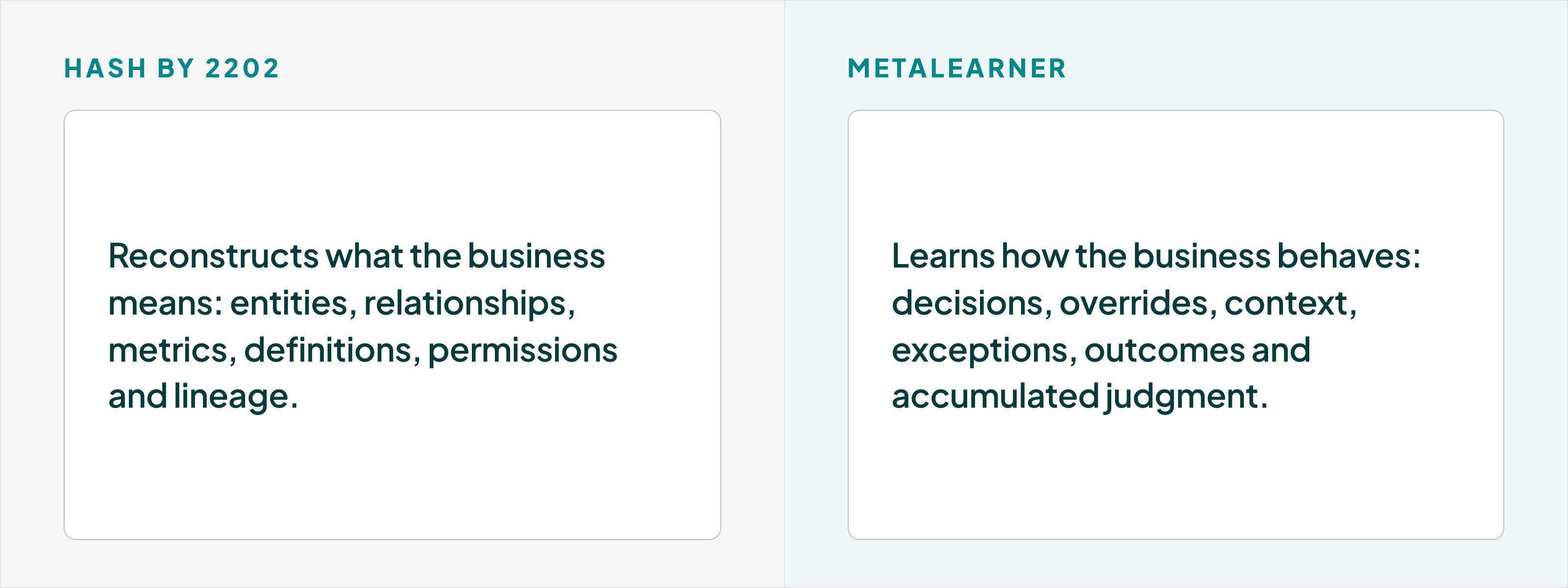
One describes institutional structure. The other captures institutional experience. Together, they create a much richer foundation for decision intelligence.
From system of record to system of understanding
This suggests an architecture for the next generation of enterprise operations:
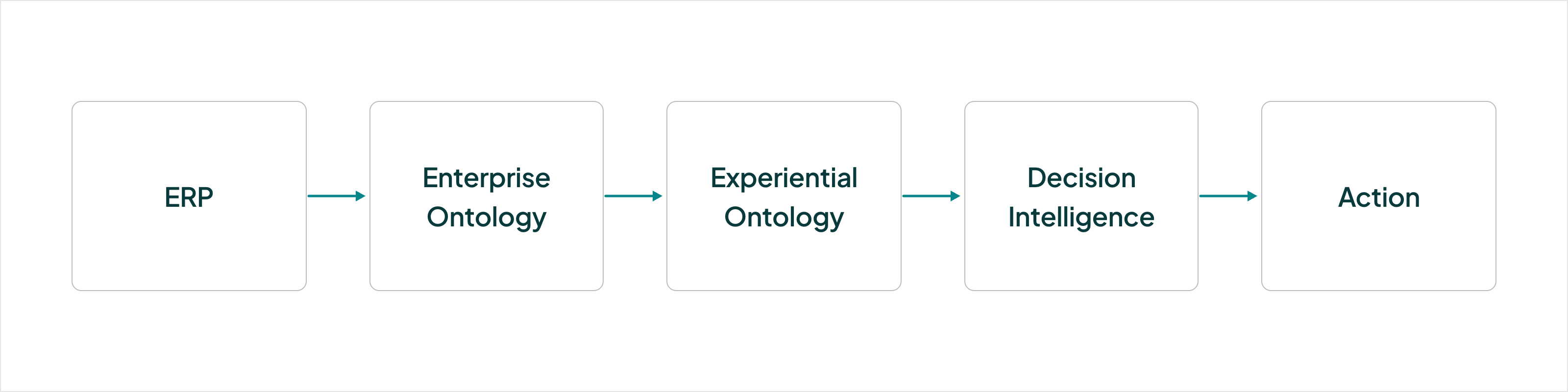
The ERP remains indispensable. It remains the system of record.
HASH can transform those records into a governed representation of what the business means: a machine-readable graph of entities, definitions, relationships, permissions, metrics and lineage.[3]
On top of that foundation, MetaLearner's experiential ontology can capture how the business behaves: what planners change, why they change it, what circumstances caused the intervention and what happened afterward.[2]
Above it, MetaLearner's forecasting and robust optimization layers become the system of decisions, continuously determining what the organization should do under uncertainty.[1][2]
ERP remains the system of record.
The experiential ontology becomes the system of understanding.
Decision layers act under uncertainty.
HASH can accelerate and strengthen that process by giving the experiential layer a governed semantic foundation from the beginning. Learning the reason behind an override is valuable. Learning the reason behind an override tied to an incorrectly mapped SKU, ambiguous inventory definition or inconsistent customer hierarchy is dangerous.
The quality of accumulated experience depends on the quality of the world model to which that experience is attached.
The compounding loop
This is where MetaLearner potentially becomes more interesting over time.
Traditional enterprise software largely depreciates. A company implements the system. Employees learn it. The software eventually becomes legacy infrastructure.
A genuine experiential decision system can behave differently.
Every planning cycle creates new information. The forecast produces a recommendation. The optimizer produces a decision. The planner accepts or modifies it. The system records the context. Reality produces an outcome. The outcome becomes evidence. The system updates its understanding.[2]
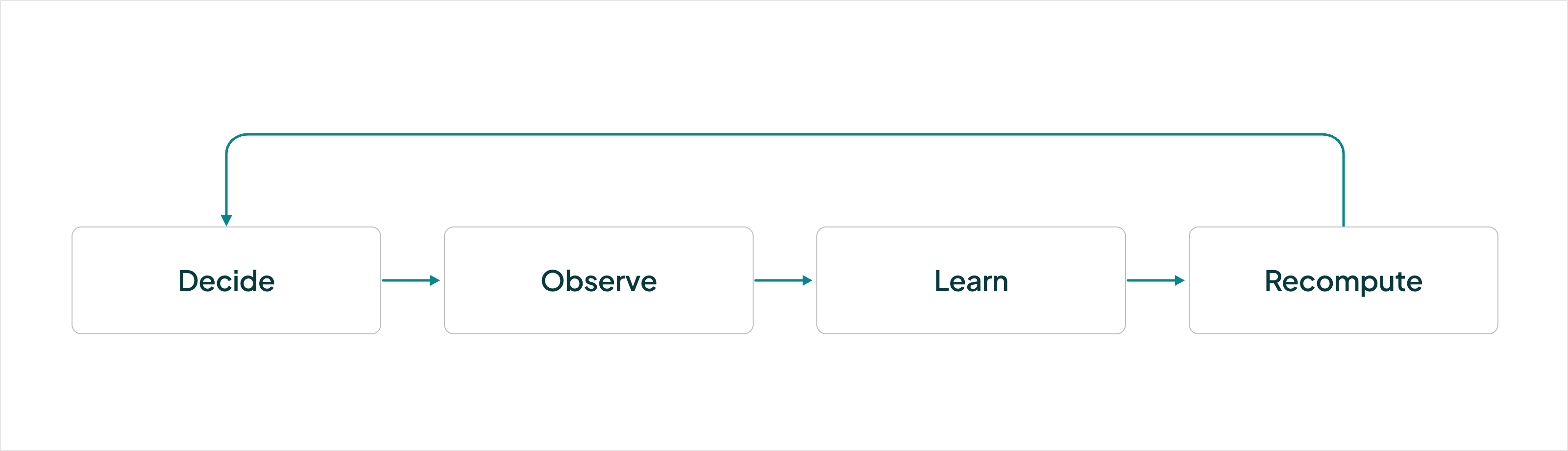
The organization's operating experience begins to compound. A planner who has spent 20 years understanding a business no longer represents only an individual key-person dependency. Some portion of that accumulated judgment can gradually become institutional infrastructure.
This is why MetaLearner's experiential ontology may ultimately be more important than another incremental improvement in forecasting accuracy. Models can be replaced. Compute gets cheaper. Optimization algorithms improve. But a proprietary representation of how a specific company actually behaves - built from decisions, exceptions, outcomes and relationships - is much harder to reproduce.
HASH makes the underlying institutional context machine-readable. MetaLearner makes the institution's operating experience learnable. Robust optimization makes that understanding actionable.
From prediction software to decision intelligence
This is also why MetaLearner should resist being categorized as simply another AI forecasting company. Forecasting is an important component of the architecture. It is not the category.
Decision Intelligence for Operations
The hierarchy is straightforward:
ERP tells you what happened.
Forecasting tells you what may happen.
MetaLearner tells you what to do.
And as its experiential ontology grows, it increasingly learns from what your organization does next.
That is a significantly larger ambition. The same architecture that determines inventory can eventually reason about pricing, production, purchasing, fulfillment, transportation, working capital and other operational decisions where uncertainty and constraints interact.
At that point, enterprise AI begins to move beyond copilots answering questions. It starts participating in how the company allocates resources.
The real opportunity
The most compelling MetaLearner sales conversation therefore should not begin with artificial intelligence.
It should begin with a CFO question: How much capital are you using to compensate for uncertainty?
Then a COO question: How much additional inventory are you carrying because your planning system cannot confidently make decisions when the forecast is wrong?
And finally an organizational question: How much operating knowledge disappears every time an experienced employee makes a decision your systems never learn from?
MetaLearner's answer connects all three.
Robust optimization improves the service-capital trade-off today. Signal-efficient forecasting and computation make the architecture scalable. Experiential ontology allows operational intelligence to compound tomorrow. HASH by 2202 can provide the governed enterprise representation beneath that learning system so customers, products, inventory, metrics, relationships and business definitions mean the same thing everywhere the system reasons.
The result is no longer just a forecasting application. It becomes an architecture for converting enterprise data, uncertainty and accumulated human judgment into increasingly better decisions.
The companies of the past bought reliability with inventory.
The companies of the future should be able to buy it with intelligence.
STOP BUYING SERVICE WITH INVENTORY.
Higher service. Less capital. Better decisions.
Sources and revision notes
Numbered references in the article correspond to the sources below. Internal deployment figures are presented as observed ranges and should remain qualified in any external publication.
[1] MetaLearner. "Turning Forecast Uncertainty into Inventory Decisions with NVIDIA cuOpt."
Supports robust optimization methodology, the 52-week / 17-warehouse / 63-item backtest, 94.9% service level, $4.51M average inventory, the fixed-buffer comparison, rolling-horizon control, liquidity constraints and NVIDIA cuOpt implementation.
[2] MetaLearner. "The Most Valuable Data in Your Business Is Being Ignored."
Supports the experiential-ontology thesis, planner overrides as knowledge, the four-step capture loop (what changed, why, conditions, implications), and the architecture in which ERP is the system of record, experiential ontology is the system of understanding, and decisioning acts under uncertainty.
[3] 2202. "While AI Chased the Latest Model, We Spent Two Years Building the Business Graph."
Supports the HASH by 2202 enterprise-ontology architecture: governed business meaning, entities and relationships, metric definitions, permissions, lineage, data-quality observability, and the concept of a machine-readable graph of knowing.
[4] MetaLearner. "MetaLearner Ontology: Connecting Business Context to AI Agents."
Supports the role of ontology and knowledge engineering in connecting ERP schemas to business concepts, relationships, hierarchies and decision-oriented AI.
[5] MetaLearner. "MetaLearner's Automated Intelligence Stack."
Supports the forecasting architecture, including feature selection, model selection, stacking, uncertainty intervals, and the broader automated intelligence stack.
[6] MetaLearner. "Extracting More Signal From Every Unit of Compute."
Reference link supplied for the campaign and revision process. Use for the signal-efficient computation narrative and any detailed feature-elimination benchmark claims if those metrics are retained in a later revision.
